KiCad design blocks
A design block is a circuit you can drop into a KiCad schematic. These ones are drawn from a manufacturer's datasheet, and each value lists the page it came from.
They use KiCad's design-block format (KiCad 9 and later), so you can add them to KiCad directly, or insert them from inside Crossprobe. A block is marked draft until a person has checked each value against the datasheet.
The whole library is open source (Apache-2.0) on GitHub: Crossprobe-AI/kicad-design-blocks. Clone it and add the crossprobe.kicad_blocks folder in KiCad, or open an issue when a value is wrong.
-
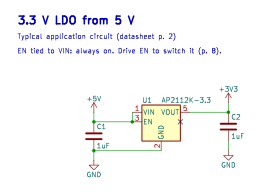
3.3 V LDO from 5 V (AP2112K-3.3) Draft
AP2112K-3.3 low-dropout regulator with the 1 µF input and output capacitors from the datasheet's typical application, enabled permanently from the input. Turns a 5 V rail into 3.3 V at up to 600 mA.
-
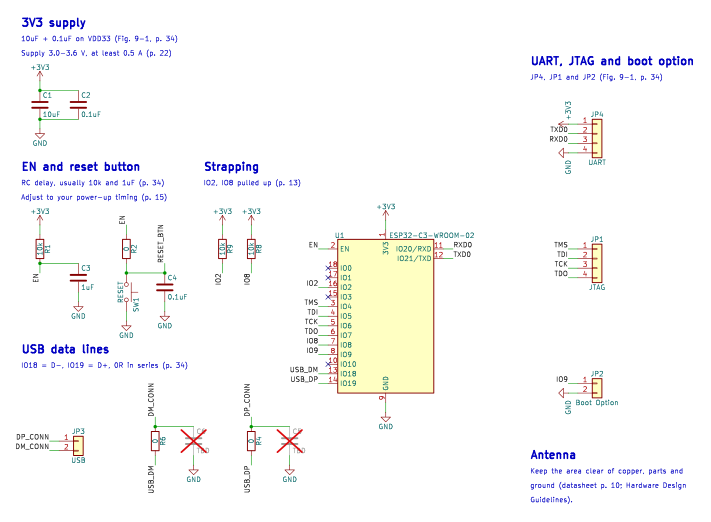
ESP32-C3-WROOM-02 minimal system Draft
ESP32-C3-WROOM-02 module with the peripheral circuit from Espressif's datasheet: 3V3 decoupling, EN reset network and button, the boot-strap pull-ups, USB D+/D- with series resistors, UART, JTAG and a boot-option header.
-
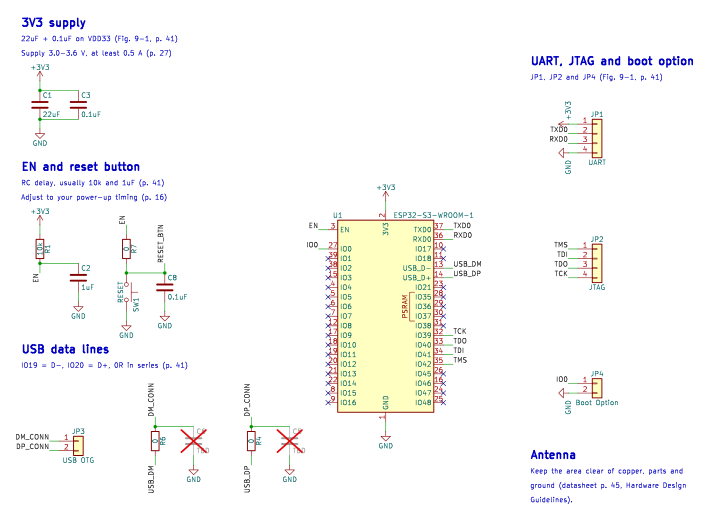
ESP32-S3-WROOM-1 minimal system Draft
ESP32-S3-WROOM-1 module with the peripheral circuit from Espressif's datasheet: 3V3 decoupling, EN reset network and button, USB D+/D- with series resistors, UART, JTAG and boot-option headers.
-
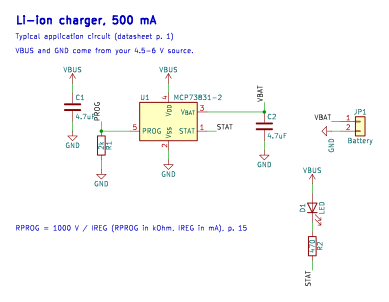
Li-ion charger, 500 mA (MCP73831) Draft
MCP73831-2 single-cell Li-ion/Li-polymer charger with the typical application circuit from Microchip's datasheet: 4.7 µF input and output capacitors, 2 kΩ programming resistor for 500 mA, and a status LED.
-
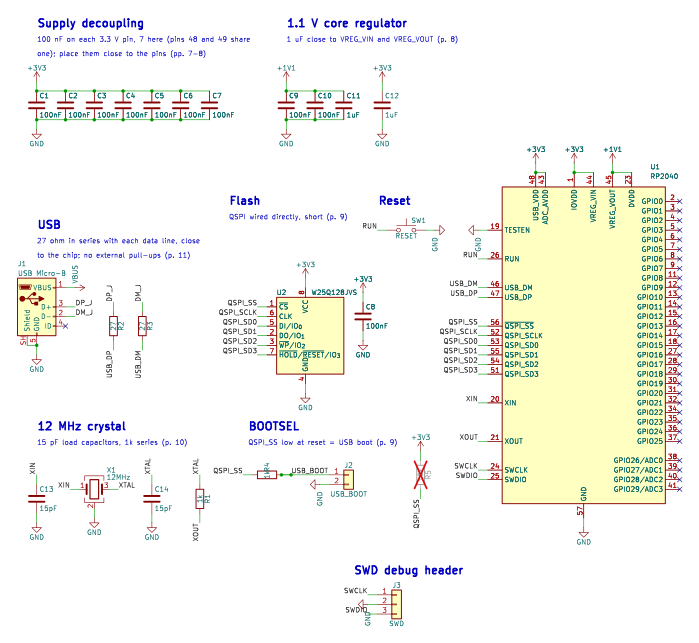
RP2040 minimal system Draft
RP2040 with the circuit from Raspberry Pi's minimal design: supply decoupling, the internal regulator capacitors, a W25Q128JVS flash, the 12 MHz crystal, USB with series resistors and a BOOTSEL header. It takes 3.3 V from outside.
-
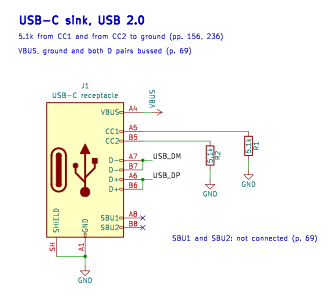
USB-C power input (5 V, USB 2.0) Draft
A USB-C receptacle for a device that takes 5 V from a USB-C source and uses USB 2.0 data: the two 5.1 kΩ pull-downs on CC1 and CC2, the VBUS, ground and data pins bussed as the Type-C specification requires, and the unused SBU pins left open.