What the design review checks
Rule checks find broken rules. A review finds what no rule describes. Crossprobe runs KiCad-equivalent checks first, then the model reasons about the design and reports findings that name the parts and nets involved.
Coverage
| Code | Area | What it looks for |
|---|---|---|
PWR |
Power and regulators | Every supply pin on a sensible rail. Regulators with their input and output capacitors. Rail voltages that suit the parts on them. |
DEC |
Decoupling | Bypass capacitors at each IC, bulk capacitance on each rail, decoupling on the wrong net. |
PIN |
Pins and pull-ups | Floating inputs. Missing pull-ups on reset, enable, boot and I²C. Outputs driving each other. |
NET |
Net hygiene | Single-pin nets, labels that split a net (SDA and SDA1), misnamed power symbols. |
PRT |
Parts and footprints | Values that don't fit their footprint, polarity mismatches, missing footprints, DNP parts on critical paths. |
PCB |
Routing | Unrouted connections, power on thin tracks, small vias carrying current, board and schematic out of sync. |
DRC |
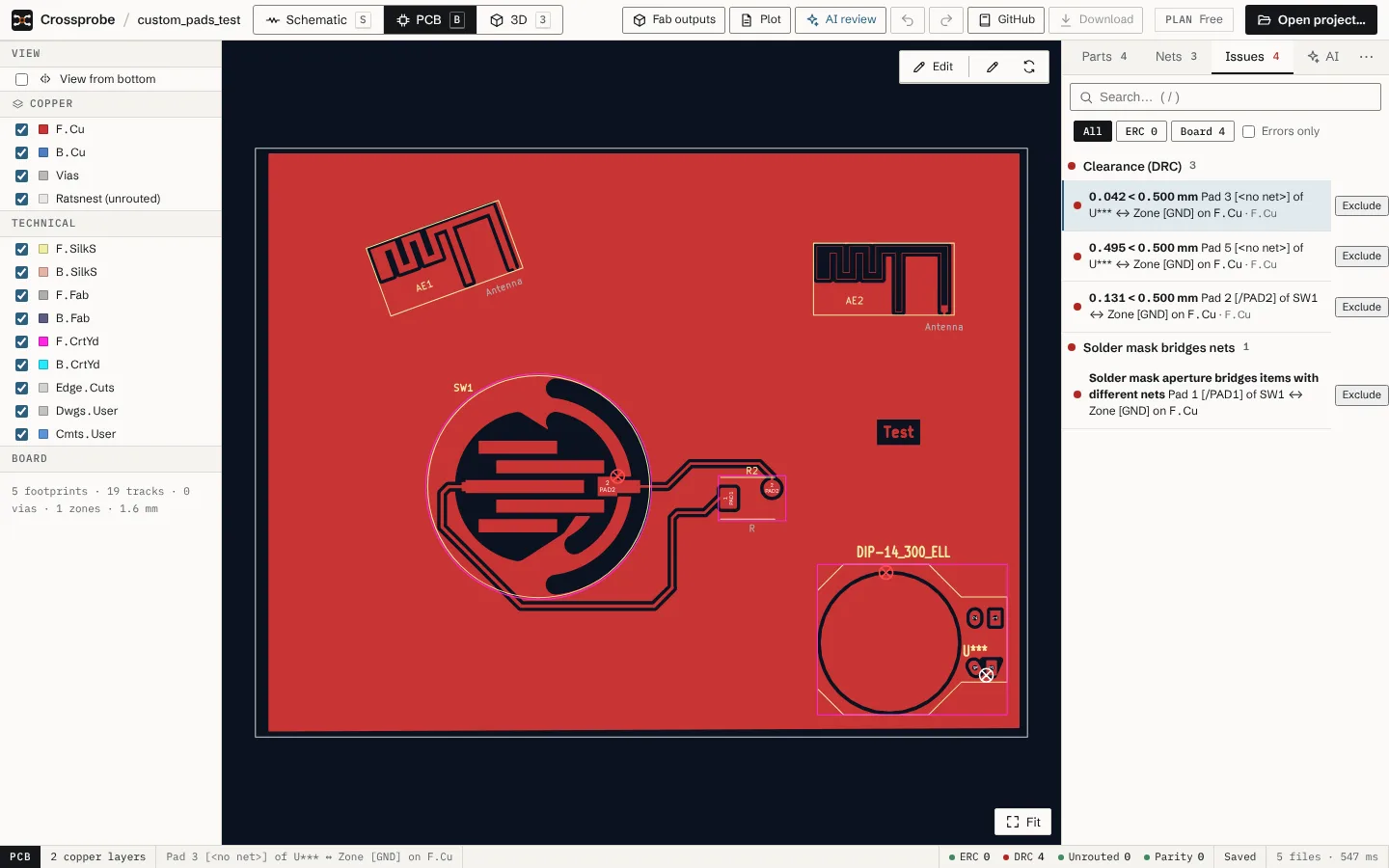
ERC and DRC triage | Hundreds of warnings reduced to the few that matter. The benign ones are explained. |
GAP |
Limits, stated | The summary lists what couldn't be verified, such as ratings that need a datasheet. |
How it works
The model never sees your files as a whole. It asks questions through read-only tools that query a KiCad-exact model of the netlist and board: the overview, one component's pins, one net's connections, the check results, the routing of a net. It records a finding when the evidence supports one. The review prefers a few well-evidenced findings to a long list of guesses, and when it relies on general part knowledge, it says so.
The ERC, clearance DRC and schematic/PCB parity results it triages are Crossprobe's own checks, which match KiCad's: netlists are identical to kicad-cli on 35 projects, and clearance results match KiCad's DRC on 17 boards.
Where it runs
The review uses a Claude model from Anthropic on Amazon Bedrock, with routing kept inside the EU. Only the tools' answers reach the model. Nothing is stored, and nothing is used for training.
To check by hand as well, the KiCad design review checklist covers the same ground, step by step.